If you’re a brand owner, importer, or packaging manager, you’ve probably already heard the term extended producer responsibility — and you may even be registered with a scheme. What many compliance teams underestimate, however, is just how variable, jurisdiction-specific, and rapidly evolving the fee structures behind EPR truly are — and how costly misreading them can be. In this guide, you’ll get a precise breakdown of how EPR fees are structured, calculated, and paid across major global markets, so you can budget accurately, comply confidently, and avoid the penalties that catch unprepared businesses off guard.
| ✦ Key Takeaways |
| ✦ Extended Producer Responsibility fees are charges levied on producers, importers, or brand owners to fund the collection, sorting, and recycling of products or packaging at end of life. ✦ EPR fee rates vary by material type, weight placed on market, and jurisdiction — meaning a single business operating across multiple regions may face several distinct fee obligations simultaneously. ✦ Eco-modulation is a fee adjustment mechanism that rewards producers using recyclable or recycled-content packaging with lower fees and penalises hard-to-recycle materials with higher rates. ✦ Businesses below defined tonnage or revenue thresholds may qualify for exemptions or reduced reporting obligations, but thresholds differ significantly by country and scheme. ✦ Failure to register with a Producer Responsibility Organisation (PRO) or accurately report tonnage data can result in retroactive fee liability, financial penalties, and import restrictions. ✦ EPR legislation is expanding globally — with the USA, Australia, and emerging markets rapidly adopting packaging EPR schemes — making proactive compliance a strategic business priority rather than a regional concern. ✦ Compliance management software can automate data collection, fee calculation, and multi-jurisdiction reporting, significantly reducing the administrative burden for businesses with complex supply chains. |
What Are Extended Producer Responsibility Fees and How Do They Work?
Extended Producer Responsibility fees are financial charges imposed on producers, importers, or brand owners to fund the collection, sorting, and recycling of the products or packaging they place on the market. Rather than leaving end-of-life management costs entirely to local governments and taxpayers, EPR fee systems shift those costs upstream — directly to the entities that profit from bringing materials into circulation.
EPR as a policy concept originated in Germany in the early 1990s with the introduction of the Grüner Punkt (Green Dot) scheme for packaging waste. Since then, it has expanded to cover dozens of material streams — from electronics and batteries to textiles, tyres, and pharmaceuticals — across more than 60 countries worldwide.
The mechanics of EPR fees are straightforward in principle. A business that places packaging, electronics, or other regulated products on the market is required to register with an authorised scheme or Producer Responsibility Organisation (PRO). That PRO collects fees based on the weight and type of material the business has reported placing on the market. The pooled funds are then used to contract waste collectors, sorting facilities, and recyclers to meet national recycling targets on behalf of registered producers.
For example, a food manufacturer placing 500 tonnes of mixed plastic packaging on the UK market annually would calculate their annual EPR fee by multiplying that tonnage by the applicable per-tonne rate for their plastic subcategory — a figure that in the UK context can range from a few hundred to over a thousand pounds per tonne depending on recyclability.
what is extended producer responsibility
Why EPR Fees Matter for Your Business
EPR fees matter because they represent a direct, unavoidable operating cost that is growing in both scale and geographic scope — and businesses that treat them as an afterthought face significant financial and legal exposure. The global EPR market for packaging alone was valued at approximately USD 45 billion in 2022 and is projected to reach USD 104 billion by 2030 — Source: Allied Market Research, 2023. That trajectory reflects the rapid expansion of mandatory EPR legislation worldwide.
First, the cost impact is material. For businesses with high packaging intensity — consumer goods, food and beverage, e-commerce — EPR fees can represent hundreds of thousands of dollars or euros per year. Underreporting, even accidentally, creates retroactive liability when audits occur.
Second, market access is increasingly conditional on EPR compliance. In the European Union, France, Germany, and Spain already enforce EPR registration as a prerequisite for selling packaged goods. Failure to register can result in products being removed from sale — a far more damaging outcome than the fee itself.
Third, eco-modulation is changing the strategic calculus for packaging design. As more jurisdictions adopt fee structures that reward recyclable packaging and penalise problematic materials, EPR fees are becoming a direct financial incentive for sustainable design — not just a compliance cost.
eco-modulation in packaging regulations
Which Products and Materials Are Subject to EPR Fees?
EPR fees apply to a broad and expanding range of product categories, with packaging waste currently representing the most widely regulated stream across global markets. Understanding which materials your business places on the market is the essential first step in calculating your fee liability.
Packaging Waste
Packaging EPR is the most mature and widespread category. Regulated packaging materials typically include:
- Plastic (rigid and flexible, with subcategories by polymer type)
- Paper and cardboard (fibre-based packaging)
- Glass containers
- Metal packaging (aluminium and steel)
- Wood packaging (pallets and crates above defined thresholds)
- Composite/multi-layer materials
Fee rates differ across these material types — glass, for example, typically attracts lower per-tonne fees than flexible plastic laminates, which are harder to recycle and carry higher eco-modulation penalties in eco-modulated schemes.
Electronics and Electrical Equipment (WEEE)
WEEE fees apply to producers of electrical and electronic equipment and fund take-back and recycling systems for consumer electronics, appliances, lighting, and IT equipment. WEEE schemes operate across the EU, UK, Australia, Canada, and many US states. Fee rates are calculated per unit or per kilogram placed on the market, and category-specific rates vary significantly between, for example, large household appliances and small IT accessories.
WEEE producer responsibility obligations
Batteries, Tyres, and Textiles
Batteries and accumulators are subject to EPR fees in the EU under the revised Battery Regulation, with obligations for both portable and industrial batteries expanding significantly from 2024 onwards. Tyre EPR schemes operate in Canada, South Korea, and several EU member states. Textile EPR — notably pioneered in France — is now being studied for adoption across the EU and in several US states, representing a significant emerging fee obligation for fashion brands and importers.
How Are EPR Fees Calculated — and What Is Eco-Modulation?
EPR fee calculation typically involves multiplying the total weight of material placed on the market (in tonnes) by a material-specific fee rate set by the relevant Producer Responsibility Organisation or regulatory authority. This basic formula applies across most global schemes, though the inputs — tonnage, rate, and adjustments — vary considerably by jurisdiction.
The Basic Calculation Formula
The core formula is:
Annual EPR Fee = Tonnes Placed on Market × Material Fee Rate
For a business placing 200 tonnes of cardboard packaging and 50 tonnes of PET plastic on the French market, for example, the calculation would apply the applicable per-tonne fee rates for each material separately, then aggregate. In France’s REP Emballages scheme, fees are paid to the authorised eco-organism (such as Citeo), which sets the per-tonne rates annually.
The following table illustrates indicative EPR fee rate ranges across major material categories and jurisdictions (rates are indicative and subject to annual revision — always verify with your registered PRO):
| Material | EU (indicative) | UK | France | Germany |
| PET Plastic | €150–€400/tonne | £200–£600/tonne | €100–€350/tonne | €200–€500/tonne |
| HDPE Plastic | €120–€350/tonne | £180–£500/tonne | €90–€300/tonne | €180–€450/tonne |
| Cardboard/Paper | €20–€80/tonne | £30–£120/tonne | €10–€60/tonne | €30–€100/tonne |
| Glass | €10–€40/tonne | £15–£60/tonne | €5–€25/tonne | €15–€50/tonne |
| Aluminium | €100–€300/tonne | £150–£400/tonne | €80–€250/tonne | €150–€350/tonne |
What Is Eco-Modulation?
Eco-modulation is an EPR fee adjustment mechanism that lowers fees for packaging made from recyclable or recycled-content materials and increases fees for packaging that is difficult to recycle, incentivising producers to redesign toward circularity. Put simply, it makes the fee you pay a direct function of how sustainable your packaging is.
Eco-modulation adjustments typically apply bonuses and penalties on top of the base material rate. For example, a PET bottle with 30% recycled content and a detachable label might attract a 20% fee reduction, while a black plastic tray (which cannot be detected and sorted by optical sorting equipment) might attract a 50% surcharge — Source: CITEO Eco-Modulation Schedule, 2024.
Eco-modulation is accelerating as regulators recognise that flat-rate fee systems provide no design incentive. The EU’s Packaging and Packaging Waste Regulation (PPWR), currently progressing through the legislative process, explicitly mandates eco-modulation across all EU member state EPR schemes. This represents a structural shift: EPR fees will increasingly function as a packaging design policy instrument, not just a cost-recovery mechanism.
Who Is Legally Responsible for Paying EPR Fees?
Under EPR legislation, the “producer” liable to pay fees is defined as the entity that first places regulated products on the national market — typically the brand owner, importer, or online marketplace seller. Identifying and correctly allocating producer responsibility is one of the most common sources of compliance confusion, particularly for businesses operating across complex supply chains.
Defining the “Producer” Under EPR Law
In most EPR frameworks, the legal producer is determined by these rules:
- Brand owner manufacturing domestically — the manufacturer bears producer responsibility
- Importer placing foreign-manufactured goods on the domestic market — the importer is the producer
- Online marketplace sellers — in increasingly many jurisdictions (including the EU’s PPWR and certain US states), marketplace operators bear producer responsibility for third-party sellers who don’t register independently
- Retailers own-label — the retailer is deemed the producer for private label products
For example, a UK retailer selling a French supplier’s food product under its own brand label is the legal producer for UK EPR purposes — not the French manufacturer. This distinction catches many businesses off guard when EPR registration audits occur.
packaging data reporting for EPR
Supply Chain Responsibility Allocation
Businesses can contractually shift EPR fee responsibility through supply chain agreements, but regulatory liability typically remains with the legal producer unless a formal third-party compliance arrangement is in place. Some PROs offer group registration schemes that allow responsibility to be formally transferred between supply chain parties, but these require explicit contractual and regulatory documentation.
What Are the EPR Fee Rates Across Key Global Jurisdictions?
EPR fee structures differ significantly between the EU, UK, USA, Australia, and Canada, reflecting variations in scheme design, material scope, national recycling infrastructure, and the degree of eco-modulation implemented. Businesses operating across multiple markets must navigate each jurisdiction’s scheme independently.
European Union
The EU does not operate a single EPR scheme — instead, each member state maintains its own national PRO system within the framework set by EU directives. Germany’s Duales System (Green Dot), France’s Citeo, and Spain’s Ecoembes each set their own rates, though all must meet EU-mandated recycling targets. Germany is notable for having one of the most eco-modulated packaging EPR systems globally, with over 40 distinct fee categories based on material composition and recyclability.
United Kingdom
Post-Brexit, the UK operates its own Packaging Extended Producer Responsibility (pEPR) scheme, which became mandatory for large and small producers from 2024. The UK scheme is notable for including a disposal cost fee element — meaning producers don’t just pay for recycling, but also contribute to the cost of collecting packaging from households. UK EPR fees are expected to increase significantly through 2025–2026 as cost recovery expands.
United States
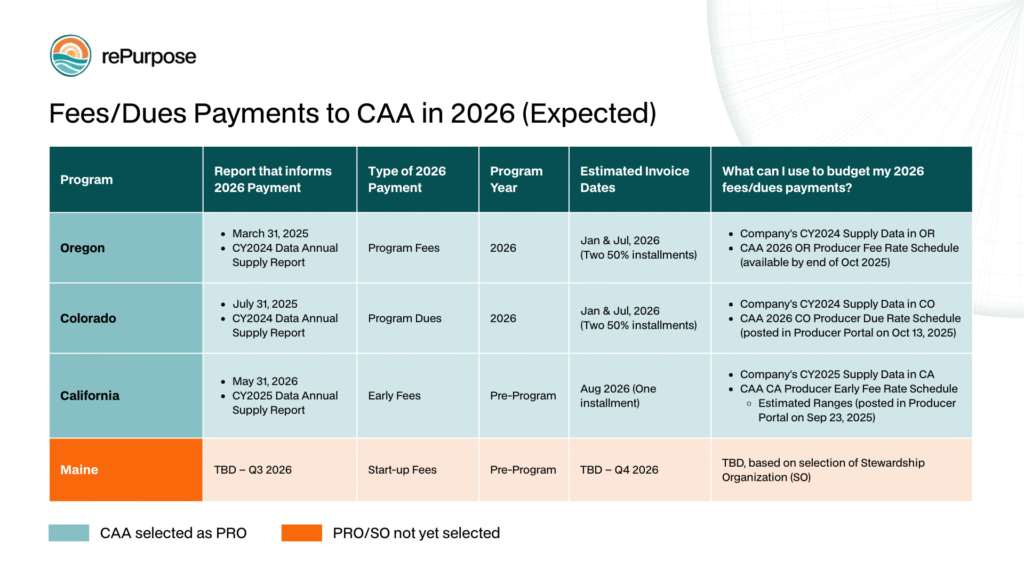
Unlike the EU and UK, the USA currently has no federal EPR packaging law. However, five states — Maine, Oregon, Colorado, California, and Minnesota — have enacted packaging EPR legislation, with more expected by 2026. Fee structures are still being developed in most US state schemes, with Oregon’s Recycling Modernization Act the most operationally advanced — Source: Product Stewardship Institute, 2024.
Australia and Canada
Australia’s National Packaging Targets (co-ordinated through APCO) are transitioning toward a mandatory EPR framework, with several states advancing their own EPR requirements. Canada operates packaging EPR schemes at the provincial level, with Ontario, British Columbia, and Quebec having the most established systems. Provincial fee rates in Canada vary considerably — Ontario’s fees can run from CAD 50 to CAD 400 per tonne depending on material.
Are There EPR Fee Exemptions for Small Businesses or Low-Volume Producers?
Most EPR schemes include exemption thresholds based on annual packaging tonnage, revenue, or both — meaning businesses below defined limits may face reduced obligations or none at all. However, these thresholds vary significantly by jurisdiction and should never be assumed without verification.
EPR exemption thresholds by country
In the UK, producers placing less than 25 tonnes of packaging on the market annually (or with annual turnover below £1 million) are classified as small producers with simplified reporting obligations. In Germany, there is no minimum tonnage exemption — all producers placing packaging on the market, regardless of volume, must register with the Zentrale Stelle (ZSVR). In US state schemes, exemptions are typically based on revenue thresholds — Oregon’s scheme, for example, exempts producers with annual US gross revenue below USD 5 million.
The key principle is this: the absence of a fee obligation in one jurisdiction does not imply exemption in another. Businesses should conduct a jurisdiction-by-jurisdiction threshold analysis before assuming they are exempt anywhere.
How Do You Register, Report, and Pay EPR Fees Step by Step?
The EPR compliance workflow involves four core steps: producer registration with a PRO or competent authority, packaging data collection and tonnage calculation, annual data reporting, and fee payment — each with jurisdiction-specific deadlines and requirements.
Step 1: Determine Your Producer Status and Jurisdictions
Before registering anywhere, map every market where you place regulated products. List the applicable EPR categories (packaging, WEEE, batteries, etc.) and confirm your legal producer status in each. This assessment drives all downstream compliance activities.
Step 2: Register with the Relevant PRO or Authority
In most EU member states and the UK, producers must register with an authorised PRO (such as Citeo in France, Grüner Punkt in Germany, or Valpak/DS Smith in the UK) or, in some jurisdictions, directly with the competent authority. Registration typically requires business entity information, product category declarations, and estimated annual tonnage.
Producer Responsibility Organisation comparison
Step 3: Collect Packaging Weight Data
Accurate tonnage reporting requires systematic collection of packaging weight data across your entire product range. This means recording the weight per unit of primary, secondary, and tertiary packaging for every SKU, then multiplying by units sold in each market. Many businesses find this step the most operationally demanding, particularly for companies with large SKU counts or complex supply chains.
Step 4: Submit Annual Reports and Pay Fees
Reporting deadlines and fee payment schedules vary by jurisdiction. France’s Citeo scheme requires annual declaration by 31 March for the previous calendar year. Germany’s LUCID portal requires annual updates by 15 May. UK pEPR reporting follows a quarterly schedule. Fees are typically invoiced following data submission, with payment due within 30–60 days.
What Happens If You Don’t Pay EPR Fees — Penalties and Enforcement?
Businesses that fail to register with a PRO, under-report their packaging tonnage, or miss fee payment deadlines face retroactive fee liability, financial penalties, and in some jurisdictions, restrictions on placing products on the market. EPR enforcement is intensifying as regulatory authorities invest in cross-border data sharing and audit capabilities.
In Germany, operating without LUCID registration is a regulatory offence that can result in fines of up to €200,000 per violation — Source: Zentrale Stelle Verpackungsregister (ZSVR), 2023. French authorities can impose administrative penalties and require removal of non-compliant products from the market. In the UK, the Environment Agency has signalled escalating enforcement activity for the pEPR scheme from 2025 onwards.
The risk calculus is clear. EPR fee obligations, even if substantial, are almost always less costly than the combination of back-fees, penalties, legal costs, and reputational damage associated with non-compliance.
EPR penalties and enforcement actions
What EPR Compliance Tools and Software Help Manage Fee Obligations?
EPR compliance management software platforms automate the collection, calculation, and reporting of packaging tonnage data across multiple jurisdictions, significantly reducing the manual burden and error risk of EPR fee compliance. As EPR obligations expand globally, purpose-built tools have become a practical necessity for medium and large enterprises.
Key platforms in this space include:
- Ecoveritas — specialises in global EPR reporting across 50+ jurisdictions, with automated data feeds from ERP systems
- Lorax EPI — offers multi-country EPR compliance management with regulatory update monitoring
- Compliance & Risks — provides regulatory intelligence alongside compliance workflow management
- Greyparrot — uses AI-based waste stream analytics to support EPR reporting accuracy
- Anthesis Sustain — sustainability consulting platform with integrated EPR compliance modules
For smaller businesses, some PROs (including Citeo in France and Reclay Group in Germany) offer basic online calculation tools at no additional cost. The UK’s Environment Agency also provides free guidance documentation and tonnage calculation templates.
EPR compliance checklist for businesses
EPR compliance management software
[Insert image: Screenshot of EPR compliance dashboard showing multi-jurisdiction reporting status | Alt text: “Manage EPR fees across jurisdictions with compliance management software”]
What’s Next: How EPR Fees Are Evolving
EPR fee structures are evolving rapidly in three key directions: broader material scope, stronger eco-modulation, and the integration of digital product passports as data infrastructure for fee calculation. Businesses that monitor these trends proactively will be better positioned to manage costs and design ahead of compliance requirements.
First, material scope is expanding. Packaging EPR is now firmly established; textiles, construction materials, and single-use plastics beyond packaging are entering the EPR framework in multiple jurisdictions. France already has mandatory EPR for textiles, furniture, and DIY products. The EU is actively developing EPR frameworks for these categories under the Sustainable Products Regulation and Ecodesign for Sustainable Products Regulation (ESPR).
Second, eco-modulation is deepening. The EU’s PPWR mandates eco-modulation across all member state packaging EPR schemes, with minimum eco-modulation criteria expected to be harmonised by 2026. This means fee differentials between recyclable and non-recyclable packaging will widen — rewarding early movers who have already redesigned toward recyclability.
digital product passport requirements
Third, digital product passports will reshape data requirements. Under the EU’s ESPR, regulated products will require digital product passports containing material composition, recyclability, and lifecycle data. This infrastructure will eventually feed directly into EPR fee calculation systems, making accurate materials data a compliance prerequisite — not just a sustainability aspiration.
Conclusion
EPR fees are no longer a niche compliance concern for large multinationals — they are a mainstream cost of doing business for any producer, importer, or brand owner placing packaged goods or regulated products on global markets. Understanding the fee mechanics, jurisdiction-specific rates, eco-modulation incentives, and compliance workflows covered in this guide puts you ahead of the majority of businesses still treating EPR as an afterthought.
The strategic opportunity is real. Businesses that invest in accurate data systems, proactive PRO relationships, and recyclability-led packaging design don’t just reduce their EPR fee burden — they position themselves as preferred partners for retailers and policymakers increasingly scrutinising supply chain sustainability credentials.
Start with a jurisdiction audit. Map where you place products, confirm your producer status, and verify your current registration and reporting completeness. The cost of getting EPR fees right is a fraction of the cost of getting them wrong.